The Modern UK Consumer 2026 is Lumina Intelligence’s definitive exploration of how UK consumer mindsets, values and behaviours are evolving across food, drink, retail and eating out.
Based on an annual survey of 3,000 UK adults, the report moves beyond demographics to reveal the psychological drivers shaping choice unpacking how consumers now balance value, quality, health, experience, brand trust and convenience in an increasingly polarised economic and cultural landscape.
The Modern UK Consumer 2026 equips brands, operators, retailers and suppliers with the insight needed to align strategies with modern consumer expectations, and to anticipate where future demand will emerge.
Questions This Report Answers
- How are UK consumers redefining value beyond price in 2026?
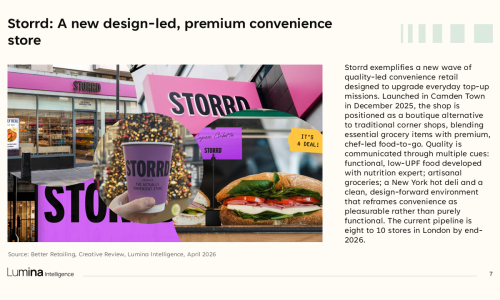
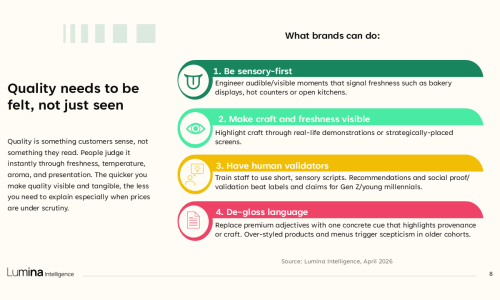
- Which quality cues most effectively justify spend — and which now raise suspicion?
- How do health beliefs differ from health behaviours, and where are the biggest belief–action gaps
- Why has healthspan, not weight loss, become the defining wellness mindset?
- How do attitudes to quality, value and brand differ across generations and income groups?
- Which experiences matter most in driving loyalty and repeat visits?
- How influential is social media in converting discovery into real world behaviour?
- When does technology enhance choice — and when does it undermine trust?
- How do the six modern consumer personas differ in priorities, behaviours and expectations?
- What do these mindset shifts mean for menu design, ranging, pricing, branding and communication strategies going into 2026 and beyond?
Who This Report Is For
- Foodservice Operators – Understand how consumer definitions of value, quality, health and experience are evolving, and how differing mindsets across generations and occasions should inform menu development, pricing strategy, service design and investment priorities.
- Retailers, Wholesalers & Symbol Groups – Gain clarity on how shoppers now balance price, quality, health and convenience, identify which cues most effectively drive trust and spend, and tailor ranging, merchandising and promotions to distinct modern consumer personas.
- Food & Beverage Brands & Manufacturers – Identify shifts in consumer expectations around taste, health, provenance and value, understand where belief action gaps exist, and shape innovation, reformulation and brand positioning to align with real world behaviours.
- Marketing, Brand & Insight Teams – Leverage deep psychographic insight and persona led segmentation to refine targeting, messaging and channel strategy, ensuring communications resonate with how different consumers genuinely evaluate quality, value and trust.
- Hospitality, Leisure & Experience Led Businesses – Assess the growing role of experience as a driver of loyalty and frequency, understand how eating out is positioned as an “affordable escape,” and adapt service models to prioritise emotional payoff over spectacle.
- Technology, Loyalty & Platform Providers – Understand how consumers interact with digital tools, customisation, self service and social media, and identify where technology enhances choice versus where it risks undermining trust and satisfaction.
- Consultants, Analysts & Investors – Access a robust, data led view of UK consumer attitudes and behaviours, including six clearly defined consumer segments, to support strategic advisory work, market assessments and long term decision making.
Consumer context & structural landscape
- An overview of the macroeconomic, cultural and psychological forces shaping UK consumer behaviour in 2026.
Graph: Consumer psychographics shift, 2024–2026
Graph: Value, quality, brand and health‑led mindset change - Economic & operating environment – Insight into cost‑of‑living pressure, household budgeting and discretionary spend reprioritisation. How macro uncertainty is reshaping necessity, treat and luxury behaviour.
Graph: UK spending intention index, Apr 2025–Apr 2026 - Consumer confidence & spending power – How confidence volatility, geopolitical instability and budget trade‑offs are influencing eating out, food‑to‑go and experience spend.
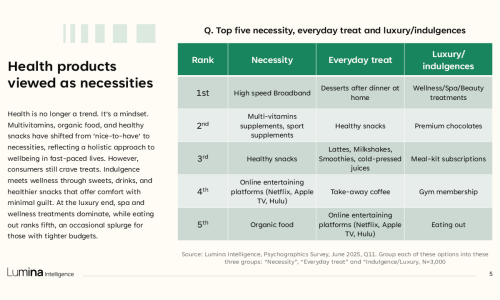
Graph: Necessity vs treat vs luxury spend classification
The UK consumer equation: Value, quality & health
- A detailed view of how consumers now evaluate food, drink and brand choices through a composite equation rather than price alone.
- The redefinition of value – How value has shifted from price to emotional, experiential and sensory cues, including atmosphere, service and perceived fairness.
Graph: Characteristics most associated with “good value” - Quality as the primary value signal – Why quality has overtaken price as the dominant decision driver, even during economic pressure.
Graph: Agreement with quality‑over‑price statements - Health as a quality benchmark – Health becoming a hygiene factor rather than a differentiator, with taste remaining non‑negotiable.
Graph: Health and taste agreement indicators
Consumer spending priorities & behavioural shifts
- A deep dive into how households are reallocating budgets and redefining indulgence.
- Spending intentions over time – Divergence between essentials, discretionary categories and eating out.
Graph: UK spending intention index by category - Necessity, treat & luxury reframed – How broadband, supplements, food delivery and eating out are being reclassified by consumers.
Graph: Necessity vs treat vs luxury categorisation
Health: From wellness trend to lifestyle operating system
- An exploration of how health has moved beyond weight loss into energy, mood, cognition and longevity.
- Health expectations & behaviour – The normalisation of healthier choices without compromise on enjoyment.
Graph: Health behaviour and mindset agreement - The say–do health gap – Where consumer intent around UPFs, fibre and balanced nutrition breaks down.
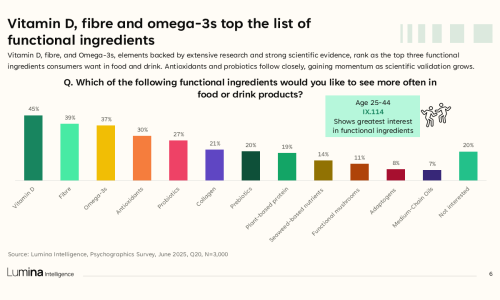
Graph: Belief vs action on healthy eating behaviours - Functional ingredients & healthspan – Rising demand for fibre, vitamin D, omega‑3s and preventative health solutions.
Graph: Functional ingredients consumers want more of
Graph: Top health goals by age group
Quality: How premium is perceived in 2026
- Understanding how consumers instinctively evaluate quality across at‑home and out‑of‑home occasions.
- Premium quality cues – Freshness, craft and brand reputation as the strongest signals of quality.
Graph: Premium quality cues ranked - Out‑of‑home quality evaluation – How taste, price, presentation and staff recommendations shape perceived quality when eating out.
Graph: Out‑of‑home quality evaluation criteria - In‑home quality evaluation – The role of freshness, ingredient lists and brand trust in retail decisions.
Graph: In‑home quality evaluation criteria
Value: From cheapness to fairness
- How “good value” is now defined by reliability, consistency and earned quality.
- What good value really means – Reliability and quality outweigh low price.
Graph: Characteristics most associated with good value - Generational differences in value perception – How portion size, décor and pricing transparency divide age groups.
Graph: Value perceptions by age group - Fair pricing & willingness to trade up – Why consumers still spend more when quality feels justified.
Graph: Willingness to pay more for quality cues
Experiences: The new currency of indulgence
- How experiences are replacing material goods as the primary outlet for discretionary spend.
- Experience seekers vs pragmatists – Profiling early adopters and experience‑led consumers.
Graph: Experiences vs material preference by age - Where experience spend goes – Travel, food festivals, theatre and concept dining dominating priorities.
Graph: Experience spend allocation
Brand, loyalty & cultural relevance
- The role of taste, trust and consistency in building brand preference.
- Why consumers choose brands – Taste and trust as the leading brand differentiators.
Graph: Reasons for choosing well‑known brands - Loyalty & partnerships – Growth of digital loyalty, collaborations and frictionless ecosystems.
Graph: Loyalty programme timeline, 2025–2026
Provenance & sustainability
- How sustainability has shifted from a differentiator to a baseline expectation.
- What provenance means – Region and reputation outweigh granular traceability.
Graph: Provenance associations ranked - Sustainability behaviour – High compliance, low voluntary engagement.
Graph: Sustainable behaviours adopted weekly
Customisation, technology & social influence
- How technology enables personalisation, discovery and conversion.
- Drivers of customisation – Preference, control and self‑expression dominating.
Graph: Reasons for food and drink customisation - Technology adoption – Apps and self‑service usage concentrated among younger cohorts.
Graph: App and kiosk preference by age - Social media influence – Platforms driving reel‑to‑real behaviour.
Graph: Platforms influencing food and drink choice
Graph: Social‑media‑driven food behaviours
Future outlook & strategic implications
- What evolving consumer expectations mean for brands and operators over the next 3–5 years.
- Strategic implications for brands – Redesigning value, health, quality and experience strategies.
Graph: Operator strategic priorities matrix
This report is based on Lumina Intelligence’s annual UK psychographics and behaviour survey, delivering a robust, data driven view of consumer attitudes and actions:
- Consumer Survey: Annual nationally representative survey of 3,000 UK adults aged 18+, fielded in June 2025.
- Indicators Analysed: 41 attitudinal and behavioural indicators covering value, quality, health, experience, brand, technology, customisation and sustainability.
- Segmentation Approach: Advanced Latent Class Analysis (LCA) used to identify natural groupings within the data, resulting in six commercially distinct consumer segments.
- Classification Certainty: Mean model certainty of 91%, ensuring strong robustness and real world applicability.
- Trend Analysis: Year on year comparisons integrated where applicable to map shifts in mindset and behaviour over time.
Download the sample
Looking for something more tailored?
Combine our core reports with additional go‑to‑market data, operator benchmarking, deeper category coverage, or a health and nutrition focus to create a bespoke solution shaped around your business priorities.