The Lumina Intelligence UK Foodservice Delivery Market Report 2026 provides the most comprehensive, data‑rich assessment of the delivery channel—quantifying market size, growth trajectories, and forecasts through to 2029.
Underpinned by Lumina Intelligence’s Eating & Drinking Out Panel, Market Sizing Insight & Analysis, and Operator Data Index, the report reveals how leading brands, aggregators, and operators are reshaping their models through digitalisation, AI‑powered optimisation, value engineering, and health‑led menu development.
With delivery becoming embedded in consumer habits, the report outlines how operators must strategically balance value, convenience, and quality to maintain market share in an increasingly competitive environment.
Questions This Report Answers
- How large is the foodservice delivery market in 2026, and how does its performance compare with the wider eating out sector?
- Which channels and brand types are growing—or declining—in share?
- How are consumer behaviours, motivations and expectations evolving?
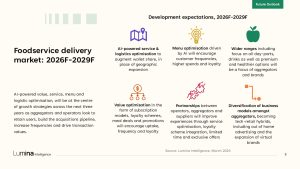
- What role will AI-driven pricing, menu engineering and logistics play in future growth?
- How will aggregator strategies reshape the market through to 2029?
- Where are the greatest risks, opportunities and white spaces for operators, suppliers and investors?
Who This Report Is For
- Foodservice Operators – Understand delivery‑specific market dynamics, channel performance, consumer motivations and emerging day‑parts to inform menu strategy, operational optimisation, platform partnerships and expansion planning.
- Delivery‑Focused & Multi‑Platform Brands – Benchmark performance against the wider delivery landscape, identify opportunities to enhance visibility across aggregators, and refine proposition, pricing and promotional architecture.
- Retailers, QSR & Coffee Shop Operators – Assess the evolving role of delivery in driving incremental revenue, strengthen bundling, range development and value-led propositions, and identify opportunities to expand participation in delivery occasions.
- Food & Beverage Suppliers & Manufacturers – Identify high‑growth categories, product innovation opportunities and shifts in consumer expectations (health, quality, convenience) to better support operator and aggregator partners.
- Aggregators & Technology Providers – Gain clarity on consumer behaviour, channel share dynamics and brand strategies to inform advertising solutions, loyalty integrations, AI‑driven optimisation and product development.
- Investors & Financial Institutions – Access a clear view of market performance, structural growth drivers, aggregator evolution and long‑term forecasts to support investment evaluation and portfolio decision‑making.
- Consultants & Industry Analysts – Leverage robust data coverage, consumer insight, competitive landscape analysis and multi‑year forecasting to support advisory projects, strategy development and market assessments.
MARKET CONTEXT & STRUCTURAL LANDSCAPE
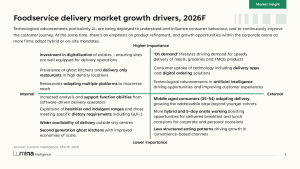
- An overview of the macroeconomic, legislative and structural forces shaping the UK foodservice delivery market in 2026.
Graph: Key economic indicators, 2019–2026F
Graph: GfK Consumer Confidence Index, 2021–2026
Graph: Average UK discretionary income by income group - Economic & Operating Environment – Insight into economic momentum, cost pressures, legislative changes and inflation. Drivers shaping consumer budget allocation and delivery behaviour.
Graph: Consumer spending trends across categories - Legislation & Policy Impact – Overview of employment law reforms, National Living Wage, HFSS restrictions, business rate reform, clean air zones and packaging regulations affecting delivery operations.
Graph: Impact timeline of legislative changes - Consumer Confidence & Spending Power
Graph: Consumer confidence trend
MARKET SIZE, VALUE & GROWTH OUTLOOK
- A detailed view of current performance, structural shifts, and forward-looking market projections.
- Total Market Performance – The UK foodservice delivery market value in 2026F, year on year growth, and comparison with the total eating out market.
Graph: UK foodservice delivery market value & growth, 2020–2026F - Sources of Market Growth – How spend, frequency, daypart expansion, digital optimisation, and premiumisation drive growth.
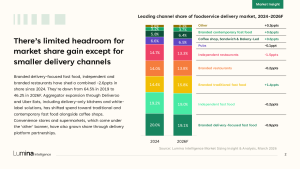
Graph: Delivery vs total eating out growth trends - Channel Share Dynamics – Which delivery channels are gaining or losing share, including branded fast food, coffee/sandwich, contemporary fast food and independents.
Graph: Leading channel share of delivery market, 2024–2026F - Forecast to 2029F – Market value projections and CAGR outlook. Identification of future engines of growth and structural risks.
Graph: UK foodservice delivery market forecast, 2023–2029F
CONSUMER BEHAVIOUR, MISSIONS & DEMAND PATTERNS
- A deep dive into consumer motivations, preferences, demographic shifts and behavioural trends.
- Penetration, Frequency & Spend Trends
Graph: Penetration, frequency & spend KPIs - Delivery Occasions by Daypart
Graph: Delivery occasions by daypart, 2024–2026 - Drivers & Motivations
Graph: Reasons for choosing brand (Top 10) - Demographic & Income Dynamics
Graph: Age share of delivery occasions
Graph: Income share & index vs total market
Graph: Region share of delivery occasions - Missions & Household Composition
Graph: Missions by daypart (lunch & dinner)
COMPETITIVE LANDSCAPE & OPERATOR STRATEGIES
- A review of aggregator dynamics, brand performance, portfolio evolution and strategic shifts.
- Aggregator Consolidation & Platform Power – The post 2025 landscape dominated by Uber Eats, DoorDash (Deliveroo) and Prosus (Just Eat). Implications for fees, visibility and bargaining power.
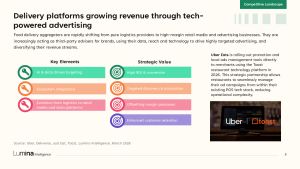
Graph: Aggregator share of delivery occasions, 2024–2026 - Aggregator Strategy Evolution – AI-led optimisation, autonomous delivery robots, retail media networks and platform personalisation.
Graph: Aggregator evolution timeline - Brand-Level Performance – How leading foodservice brands (Domino’s, McDonald’s, KFC, Greggs, Nando’s etc.) are growing delivery turnover and leveraging format diversification.
Graph: Top 10 brands by delivery turnover, 2024–2026F - Dark Kitchens & Virtual Brands – creator-led concepts, Editions/host kitchens, and delivery-only brand models.
Graph: Virtual brand growth examples - Estate Expansion & Reach
Graph: Outlets by brand, 2024–2026F - Quality, Logistics & Service Improvements
Graph: Satisfaction ratings (ordering, speed, freshness)
PRICING, VALUE & DIGITAL STRATEGY
- How brands and aggregators are using digital tools, loyalty ecosystems and pricing architecture to grow frequency and protect margin.
- Value Architecture & Pricing Mechanics – Price positioning, value tiers, subscription models, and the shift toward personalised promotions over generic bundles.
Graph: Promotion types by share of delivery occasions - Loyalty & First-Party Channels – Growth of first party delivery ecosystems, app based ordering, integrated loyalty schemes and data ownership.
Graph: Loyalty adoption & first party channel growth - Digitalisation & AI Deployment – Intelligent route optimisation, menu personalisation, predictive modelling and platform-led ad tech.
Graph: AI-led operational levers
PRODUCT, MENU & OCCASION EVOLUTION
- Emerging consumer expectations reshaping product choices, dayparts, and menu innovation.
- Health & Quality Premiumisation – Rise of high protein meals, low UPF options, healthier bundles and functional beverages.
Graph: Health & quality indices vs total market - Category Shifts
Graph: Top delivered dishes by share
Graph: Food vs drink vs bundled purchases - Occasion-Specific Innovation
Graph: Sport-related delivery occasions
FUTURE OUTLOOK & STRATEGIC IMPLICATIONS
- What the next phase of foodservice delivery looks like, and how brands should prepare.
- Market Outlook to 2029F – Growth stabilisation, long term value drivers and channel level opportunities.
Graph: Delivery market share of total eating out, 2023–2029F - Growth Drivers & Inhibitors – AI adoption, hybrid working, menu diversification vs operating costs, legislation and aggregator dependency.
Graph: Growth drivers & inhibitors matrix - Strategic Priorities for Operators – Value-led innovation, deeper partnerships, digital experience optimisation, white-label delivery integration and healthier menu development.
Graph: Operator strategic levers - Risks & Opportunities – Income polarisation, inflation recovery, technology investments and competition for wallet share.
- Eating & Drinking Out Panel – Lumina Intelligence’s Eating and Drinking Out Panel (EDOP) performs a weekly tracking of the behaviour of 1,500 nationally representative UK consumers, generating an annual sample of c.78,000 eating-out and delivery occasions across all channels and dayparts, including snacking (2020–2026).
- Market Sizing & Operator Data Index – Comprehensive market sizing of hospitality and grocery operators using turnover and outlet data, combined with Lumina Intelligence’s Operator Data Index, which tracks and forecasts outlet and revenue performance for 400+ brands across the eating-out market (2018–2029F).
- Operator & Aggregator Intelligence – Continuous monitoring of delivery operators, aggregators and platform partnerships, incorporating brand-level pricing, promotion mechanics, format evolution, digital features and channel participation trends.
- Consumer & Industry Analysis – Integration of sentiment from Lumina Intelligence’s Top of Mind Business Leaders Survey (2021–2025), capturing trading environment expectations and commercial priorities across the industry.
- Secondary External Sources – Supplementary macroeconomic and behavioural indicators including desk research, GfK Consumer Confidence Index and EY ITEM Club economic forecasts, providing contextual framing for demand, pricing sensitivity and market stability.
Download the sample
Looking for something more tailored?
Combine our core reports with additional go‑to‑market data, operator benchmarking, deeper category coverage, or a health and nutrition focus to create a bespoke solution shaped around your business priorities.