The Lumina Intelligence Eating Out Market Report 2026 provides a comprehensive view of the UK foodservice market as it moves from a period of sustained inflationary pressure into a more stable, but highly competitive, environment.
As pricing growth moderates and consumers remain selective, 2026 marks a key pivot point for operators: shifting from price-led growth towards rebuilding volume, increasing frequency and sharpening propositions. Using Lumina Intelligence’s proprietary consumer, operator and market datasets, the report explores how demand is evolving across channels, occasions and missions, and where future growth will emerge.
It examines how value perception is being redefined beyond price, the rebalancing of delivery and dine-in, and how operators are balancing cost control with investment in experience, digital capability and brand. It also highlights how changing lifestyles and hybrid working are reshaping eating out occasions.
Positioned as both a review of the current market and a forward-looking guide to 2027 and beyond, the report equips operators, suppliers and investors with the insight needed to navigate an increasingly complex foodservice landscape.
Questions This Report Answers
- How is the UK eating out market performing in 2026, and where is growth being driven across channels and occasions?
- To what extent is volume recovering, and how are operators stimulating frequency in a more price-sensitive environment?
- How are consumers redefining value, and what does this mean for pricing, promotions and proposition design?
- What role do delivery, dine-in and on-the-go missions play in the current market, and how is this evolving?
- How are eating out occasions fragmenting, and which missions present the greatest growth opportunity?
- What strategies are operators using to balance cost pressures with investment in experience and brand?
- How important is digital within the modern eating out journey, and where are the key areas of innovation?
- What trends will shape the foodservice market into 2027 and beyond?
Who This Report Is For
- Foodservice Operators (QSR, Casual Dining, Pubs & Bars) – Understand market performance, channel dynamics and evolving consumer behaviour to inform pricing strategy, menu development, format optimisation and long-term growth planning.
- Multi-Site & Challenger Brands – Benchmark performance against the wider market, identify whitespace across occasions and missions, and refine proposition, positioning and expansion strategies in a competitive landscape.
- Retailers & Convenience Operators – Assess the role of eating out missions in driving footfall and incremental spend, and identify opportunities to compete across food-to-go, meal solutions and hybrid occasions.
- Food & Beverage Suppliers & Manufacturers – Identify high-growth channels, occasions and categories, and align innovation pipelines with operator needs and changing consumer expectations around value, quality and convenience.
- Delivery Platforms & Technology Providers – Gain clarity on channel evolution, consumer usage patterns and operator strategies to inform product development, partnerships, digital solutions and platform optimisation.
- Investors & Financial Institutions – Access a clear view of market performance, structural trends, channel outlook and long-term growth drivers to support investment decisions and portfolio strategy.
- Consultants & Industry Analysts – Leverage robust consumer, operator and market-level insight to support strategic advisory, market sizing, competitive benchmarking and future forecasting.
MARKET CONTEXT & STRUCTURAL LANDSCAPE
An overview of the macroeconomic environment, consumer sentiment and structural shifts shaping the UK eating out market in 2026.
- Macroeconomic environment
Graphs: Key economic indicators, 2019–2026F / Consumer confidence index / Discretionary spend trends - Economic & Operating Environment
Insight into moderating inflation, sustained cost pressures and easing but uneven consumer demand, and how these factors are shaping operator strategies.
Graph: Consumer spend across discretionary categories - Cost Pressures & Industry Dynamics
Labour inflation, energy costs, supply chain volatility and margin recovery shaping operational decision-making across the sector.
Graph: Operator cost pressure index - Consumer Confidence & Spending Power
The impact of cautious consumer confidence and real income recovery on eating out frequency, channel choice and trading behaviour.
Graph: Consumer confidence vs eating out frequency
MARKET SIZE, VALUE & GROWTH OUTLOOK
A detailed view of total market performance, structural growth drivers and forward-looking projections.
- Total Market Performance
The total UK eating out market value in 2026F, including year-on-year growth and comparison to pre-pandemic benchmarks.
Graph: UK eating out market value & growth, 2020–2026F - Sources of Market Growth
The relative contribution of pricing, frequency, premiumisation and new occasions in driving market expansion.
Graph: Price vs volume growth contribution - Channel Share Dynamics
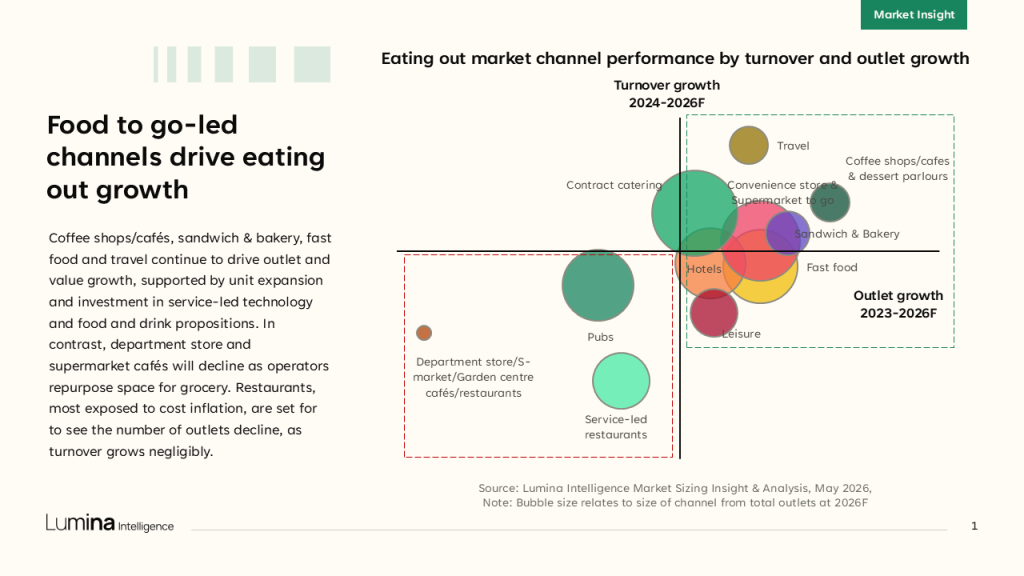
Performance across QSR, casual dining, pubs, coffee shops and travel-led channels, and shifts in market share.
Graph: Channel share of total eating out market - Forecast to 2029F
Market value projections, CAGR outlook and identification of long-term structural growth areas.
Graph: UK eating out market forecast, 2023–2029F
CONSUMER BEHAVIOUR, MISSIONS & DEMAND PATTERNS
A deep dive into how consumers engage with eating out across occasions, channels and missions.
- Penetration, Frequency & Spend Trends
Participation levels, visit frequency and spend per head across different consumer groups and occasions.
Graph: Penetration, frequency & spend KPIs - Occasions by Daypart
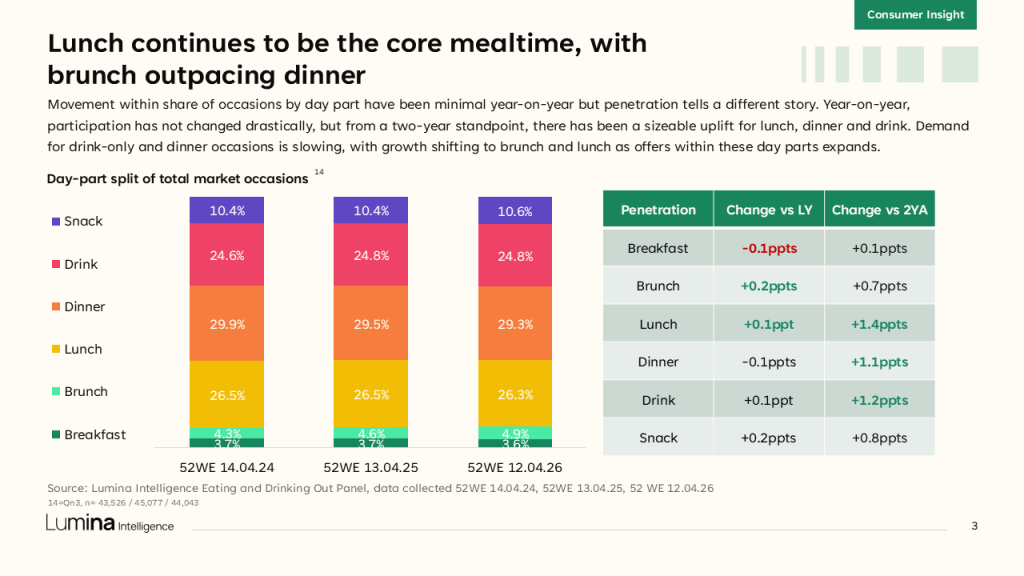
How breakfast, lunch, dinner and snack-led occasions are evolving, with growing fragmentation across dayparts.
Graph: Eating out occasions by daypart - Drivers & Motivations
The key factors influencing choice, including value perception, convenience, quality, experience and social drivers.
Graph: Reasons for choosing venue (Top drivers) - Demographic & Income Dynamics
Differences in behaviour by age, affluence and region, including the influence of younger and higher-income consumers on market growth.
Graphs: Age share of occasions / Income index vs market / Regional performance - Mission Types & Occasion Evolution
Growth of quick convenience, social dining, delivery-led and hybrid occasions driven by changing lifestyles and working patterns.
Graph: Mission mix by occasion type
COMPETITIVE LANDSCAPE & OPERATOR STRATEGIES
A review of how operators are adapting their strategies to compete in a stabilising but highly competitive market.
- Operator Performance & Market Leaders
Performance of leading operators across channels and how market share is evolving.
Graph: Top operators by market share / growth - Format & Estate Evolution
Changes in estate size, format diversification and the role of smaller, flexible or hybrid concepts.
Graph: Outlet growth by channel - Brand Positioning & Differentiation
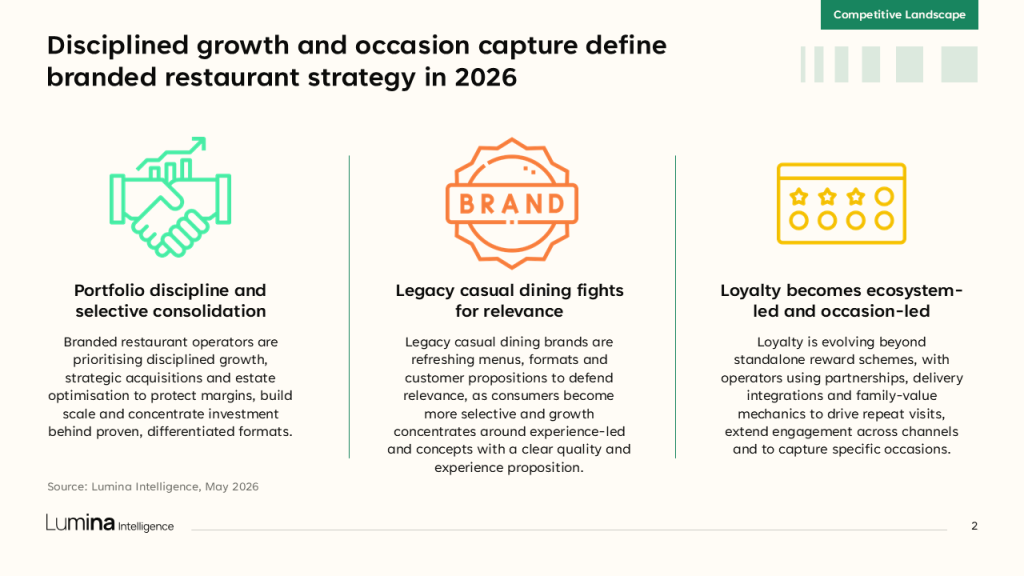
How operators are refining propositions around value, quality, experience and brand identity.
Graph: Positioning map (value vs experience) - Experience & Service Innovation
Investment in in-venue experience, service models and operational improvements to drive repeat visits.
Graph: Drivers of satisfaction & repeat visitation
PRICING, VALUE & DIGITAL STRATEGY
How operators are responding to evolving value perceptions and embedding digital across the customer journey.
- Pricing & Value Architecture
Shift from broad-based price increases to targeted pricing strategies, bundles and value-led mechanics.
Graph: Promotional types & usage - Value Perception & Trading Behaviour
How consumers evaluate value beyond price, balancing affordability with quality and experience.
Graph: Value perception drivers - Digital & Loyalty Integration
Growth of app-based ordering, loyalty ecosystems and data-driven engagement strategies.
Graph: Digital ordering & loyalty usage - Technology & Innovation
Role of automation, AI and operational technology in driving efficiency and enhancing customer experience.
Graph: Technology adoption indicators
MENU, PRODUCT & OCCASION EVOLUTION
How menus, categories and propositions are evolving to meet changing consumer expectations.
- Category Performance & Menu Composition
Growth and decline across key food and drink categories and how menus are adapting.
Graph: Category share & growth rates - Premiumisation & Quality Trends
The role of quality, provenance and premium cues in driving spend and differentiation.
Graph: Premium vs value mix - Innovation & Global Influences
Impact of global cuisines, new formats and flavour innovation on menu development.
Graph: Innovation penetration by category - Occasion-Led Propositions
Development of targeted offers for specific occasions, including sharing, on-the-go and meal solutions.
Graph: Occasion-based menu offers
FUTURE OUTLOOK & STRATEGIC IMPLICATIONS
A forward-looking view of how the eating out market will evolve and what this means for industry stakeholders.
- Market Outlook to 2029F
Long-term growth trajectory, stabilisation trends and channel-level opportunities.
Graph: Eating out share of total food spend, 2023–2029F - Growth Drivers & Inhibitors
Key forces shaping the market, including economic recovery, consumer behaviour shifts, cost pressures and competition.
Graph: Growth drivers & inhibitors matrix - Strategic Priorities for Operators
Focus areas including value optimisation, experience-led differentiation, digital integration and menu innovation.
Graph: Operator strategic priorities - Risks & Opportunities
Key uncertainties and opportunities, including income polarisation, evolving demand patterns and competitive intensity.
This report combines Lumina Intelligence’s proprietary tools with external economic indicators to deliver a robust, evidence-led view of the UK eating out market:
- Eating & Drinking Out Panel – Weekly insights from a nationally representative panel of 1,500 UK consumers (~78,000 annually), tracking behaviour across all channels, occasions and dayparts.
- Operator & Market Sizing Data – Comprehensive modelling of market value, channel performance and growth trends across the UK foodservice sector.
- Lumina Intelligence Operator Insights – Regular surveys and interviews with operators to capture sentiment, strategy and operational challenges across the market.
- Macroeconomic & Consumer Indicators – Incorporation of key external data sources, including consumer confidence, inflation and income trends, to contextualise behavioural shifts.
Download the sample
Looking for something more tailored?
Combine our core reports with additional go‑to‑market data, operator benchmarking, deeper category coverage, or a health and nutrition focus to create a bespoke solution shaped around your business priorities.